
Before you watch a single demo, there’s work worth doing. Here’s how to walk into AMS Demo Days — and the broader selection process — with clarity.
Events like ASAE’s AMS Demo Days are a fantastic way to explore the market and understand what’s out there. In two days you can see 23 different systems. That’s remarkable access — and it can also go from exciting to overwhelming fast, especially without a framework for what you’re looking at and why.
We recently hosted a webinar to help organizations prepare before the selection process begins. If you haven’t had the chance to watch yet, join us as we unpack what you need to know before you evaluate a single system.
We also put together a free quick reference guide — The Right Fit: AMS Selection Quick Guide — that covers the full process from start to finish. More on that after our top 7 tips for a successful AMS search and implementation.
1. Understand Why This Decision Feels So Big — Because It Is
An AMS isn’t just another piece of software. It’s the operational core of your association — touching membership, events, finance, communications, and education. As Moira put it during the webinar: “If we were manufacturers, this is the software that runs the plant.”
It also requires alignment across teams that don’t always share the same priorities. And it’s not easy to undo. Most organizations live with their AMS for eight to twelve years, and even if it’s not working well, switching sooner than five years is genuinely painful.
There’s also a human cost. Research from Momentive’s State of Mission-Driven Workforce report found that 82% of staff say disconnected systems contribute to burnout — and among those employees, 63% are considering leaving. Your AMS touches nearly everyone in the organization, for some people every single day. Getting this right matters.
2. Know What’s Actually Driving the Change
Before you look outward, look inward. What brought you to this point?
Common triggers include:
- Lost trust in the current system — workarounds have multiplied, spreadsheets have taken over, and people have stopped expecting the system to help them
- Poor vendor support — tickets languishing for months, no confidence that problems will actually get solved
- Outgrowing the system — it was the right fit years ago, but the organization has moved on
- Custom debt — years of custom development have created a tangle that’s harder to fix than to replace
- Institutional knowledge walking out the door — when the one person who knew why the system worked the way it did leaves, it can trigger a broader reckoning
Understanding your “why” gives your team a shared foundation and keeps the selection focused on solving real problems — not just chasing shiny features.
3. Get the Right People in the Room Early
Think about involvement in three layers.
Everyone. Cast as wide a net as possible when gathering requirements. It’s remarkable what surfaces when every team has a voice — and how those needs connect across the organization in ways you might not expect.
A selection team. Representatives from each department who commit to reading every proposal and attending every demo. They communicate back to their teams about the process — and they help you see through a polished demo to the actual things that need to get done.
A core team. One to four people who drive the process day to day. It’s critical that someone senior enough to rally the organization behind the final decision is on this team — someone who is both strategic and detailed enough to understand the technology trade-offs.
In smaller organizations, these three groups will overlap significantly. That’s fine. What matters is that all three functions are covered.
And don’t overlook the most important stakeholder of all: your members. Formally designating someone to be their voice in the room — someone who knows your member personas, their journeys, and their pain points — means you’re advocating for them, not guessing.
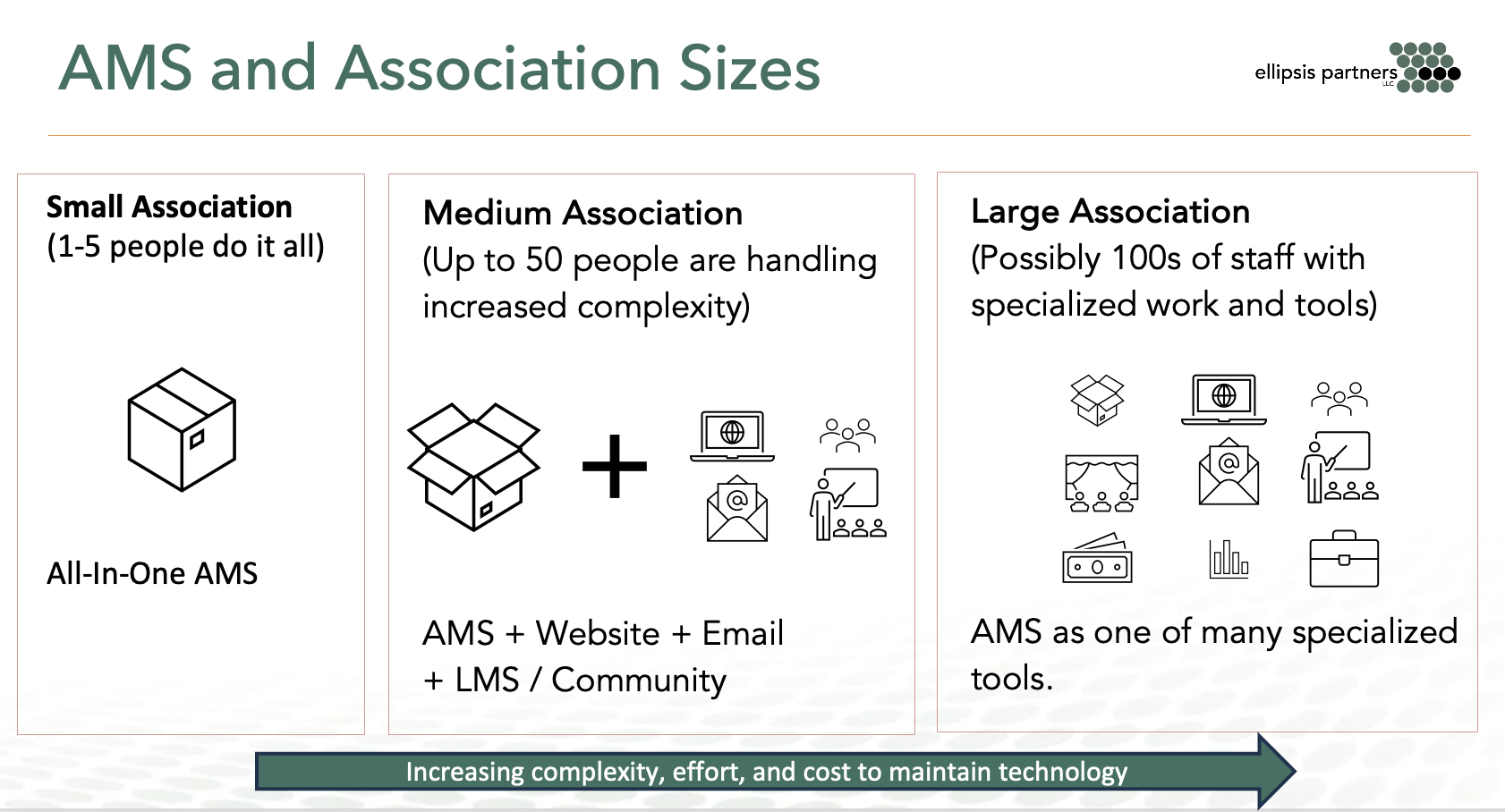
4. Know Your Size — It Shapes Everything
This may be the single most important thing to figure out before you watch a single demo.
The biggest mistake organizations make is falling in love with a system that’s the wrong fit. As Rhoni explained: “Small systems are positioned to look big and comprehensive in demos; large systems are designed to look intuitive and easy to manage.” Both are doing their job. It’s your job to know the difference.
“Buying an AMS is like buying kids’ shoes. They should fit now, have room to grow — but not be so large they trip you up.” — Moira Edwards
A system that’s too big brings overwhelming complexity, a higher price tag, and possibly the need to hire a dedicated administrator you hadn’t budgeted for. A system that’s too small means frustration and another selection process in a few years.
Think about your staff count, your revenue, and your technology team’s actual capacity — then match accordingly. We’ve seen organizations move off platforms like Salesforce not because those platforms are bad, but because they were simply too large for the team’s resources and budget to manage well. The right system is the one your organization can actually use.
We’ve also broken out AMS solutions by organization size on our website to help you start in the right neighborhood.
5. Think About the Full Cost Picture, Not Just the Price Tag
Budget conversations often anchor on licensing fees, but implementation is where the real investment happens.
A rough rule of thumb:
- Implementation: approximately $10,000 per staff member
- Annual licensing: approximately $2,500 per staff member per year
And as soon as you land on a number — add more. We’ve outlined some cost estimates based on organization size, but know there’s always the potential for an AMS to cost more than expected.

Cost Estimate by Organization Size
The full picture goes further. Factor in integration costs with your other systems, whether the new AMS can consolidate tools you’re currently paying for separately, and whether you’ll need to add staff to manage the new system. (If you’re looking at a highly configurable enterprise platform, for example, plan for a dedicated admin.)
Because all of this gets complex quickly — with one vendor recommending consolidating a product where another doesn’t, or where implementation costs are low but ongoing fees are high — we build a cost comparison grid across finalist vendors to make the tradeoffs visible. This can be a great tool when evaluating multiple AMS options.

Example of a Cost Grid for an AMS Implementation
You can find an editable version of a cost grid to use on your projects here: SAMPLE Cost Comparison Grid 2026.
6. Think About Complexity — And Where You Might Simplify
Every association has complexity drivers: unique membership structures, credentialing programs, custom business processes, deeply integrated third-party tools. The question isn’t whether you have complexity — it’s what to do about it.
Some complexity is core to your mission and needs to be supported by whatever system you choose. But some of it has simply accumulated over the years because “that’s how we’ve always done it.”
A new AMS is a genuine opportunity to simplify. We’ve worked with organizations that completely rethought a business line — like credentialing — to fit what a modern system offers out of the box, rather than rebuilding years of custom logic from scratch. That’s not cutting corners. That’s smart strategy.
For AMS Demo Days specifically, you don’t need detailed requirements. What you do need is a clear sense of the three or four things that make your organization genuinely unique, and the high-level goals and pain points the new system absolutely must address.
7. Treat AMS Demo Days as Market Research, Not a Decision
Demo Days are speed dating, not a marriage proposal.
You’ll see 30- to 45-minute overviews of many systems in a short window. In a full selection process, finalist demos run three to four hours — followed by hours of deeper dives, with a shortlist of semi-finalists you’ve already vetted. So go in with the right expectations: you’re there to understand the landscape, not to pick a winner.
Before you arrive, do your pre-thinking:
- What size system fits your organization?
- What are your major pain points and objectives?
- Who should you bring along?
But don’t worry about locking down requirements or finalizing your budget yet — that all comes later.
The most valuable thing you can walk away with is curiosity: which systems surprised you, which approaches felt like they matched how your team works, and what questions you want to dig deeper on in a full process. That’s the foundation everything else builds on.
A full AMS selection is a significant undertaking — but it doesn’t have to be an intimidating one. The organizations that navigate it most smoothly are the ones that invest in preparation first: understanding themselves, their people, their complexity, and their budget before they ever sit down to evaluate a system.
AMS Demo Days are a wonderful starting point. The work you do before you walk in is what makes them worth your time.
Take This With You
The tips in this post are drawn from a full webinar on AMS selection readiness — but if you want a single reference you can return to throughout the entire process, we built one.
The Right Fit: AMS Selection Quick Guide covers every stage from project framework to contract negotiation to implementation — the people, the process, and the decisions that matter most. It’s free, it’s practical, and it’s designed for the reality of running a selection while still doing your actual job.
Ready to go further than a guide?
Ellipsis Partners helps associations navigate every stage of the AMS selection process — from readiness assessments to vendor evaluation to implementation oversight. Reach out to start a conversation about where you are and what’s next.