
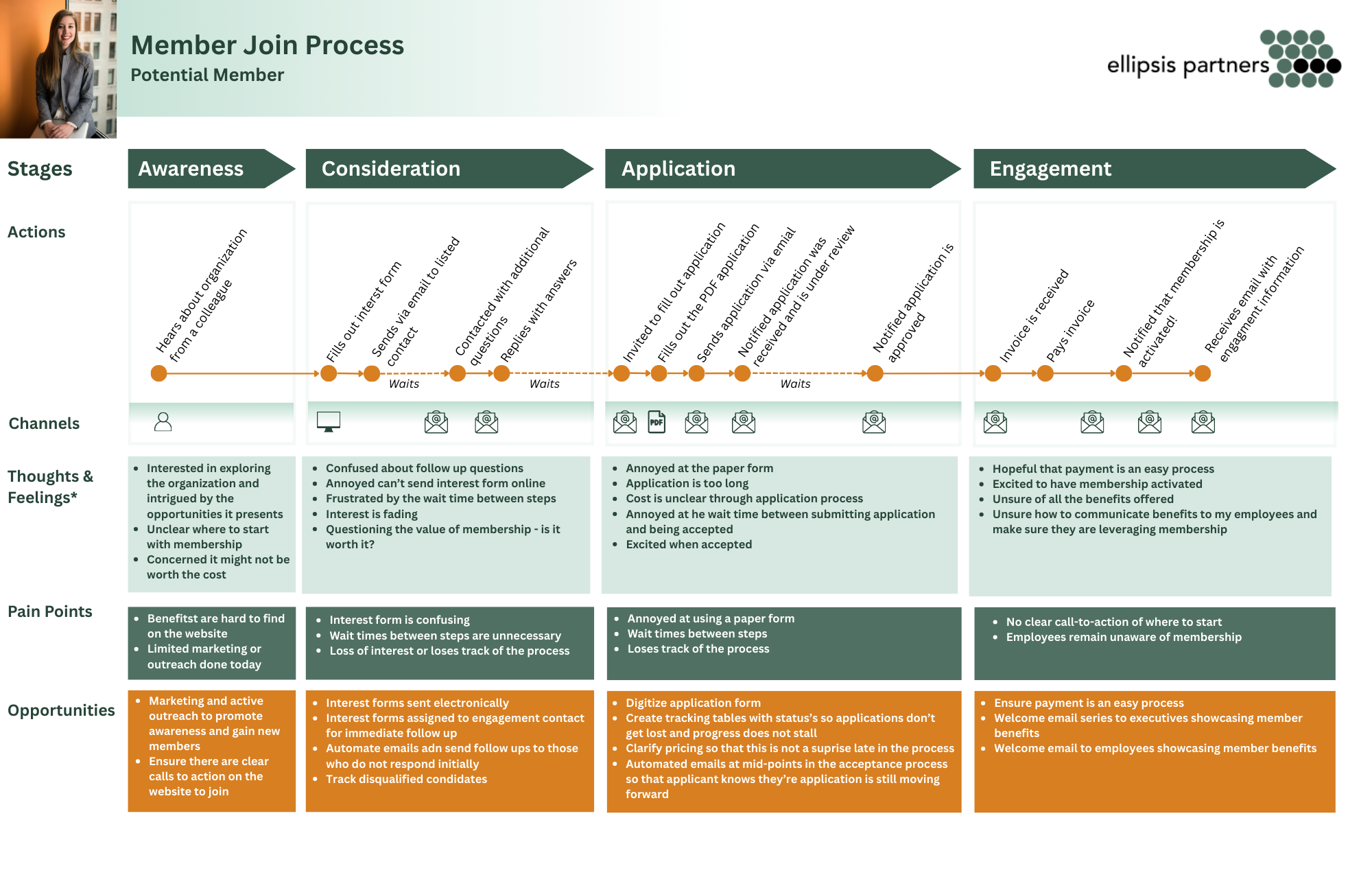
Journey mapping is a familiar topic, and there are already great resources out there that explain the fundamentals. If you’re looking for a solid introduction to what a journey map is, I recommend starting with these helpful guides from Nielsen Norman Group and the CXPA.
This article isn’t that.
This is about the practical, experience-tested lessons that matter most when you’re trying to use journey maps as decision-making tools, not decorative deliverables.
A strong journey map clarifies what’s actually happening for your audiences, reveals where their experience breaks down, and shows you exactly where to focus your improvement efforts. When done well, it becomes one of the most powerful assets in your customer experience, product, or operational toolkit.
Here are my core principles and takeaways learned after building journey maps across organizations—from volunteer onboarding to CE course registration to join/renew flows and more.
Why the Structure of a Journey Map Matters More Than the Artifact
A journey map is only as strong as the structure that guides it. At its core, a high-value journey map must:
- Document every single step of a single persona’s process from start to finish—no exceptions. capturing every step is key how granular you get is more art then science, but skipping or combining steps can lead to errors.
- Capture what people are feeling at every single moment. Joy, surprise, confusion, frustration—each emotion is a data point that helps explain why behaviors occur.
- Pinpoint the pain points tied to moments of stress, friction, or uncertainty. This is the gold. Pain points give you the “why” behind broken experiences and are the only credible foundation for generating improvement ideas.
- Translate those pain points into opportunities. A journey map is not complete until you’ve connected pain points to actionable opportunities—improvements that will reduce friction, boost satisfaction, strengthen loyalty, or streamline operations.
When Journey Mapping Makes Sense
Journey mapping takes real time and effort, so you want to deploy it where it will deliver meaningful return. Common use cases include:
“We’re not actually sure what the process is.”
If you can’t confidently articulate the steps a member, customer, or stakeholder goes through, journey mapping becomes your primary documentation tool.
“We hear a lot of complaints, but we can’t see the full picture.”
Individual pieces of feedback rarely tell a complete story. A journey map shows how those puzzle pieces fit together.
“We don’t really know what people are doing to get to complete a process.”
If your internal understanding doesn’t match reality, you’ll end up solving the wrong problems.
“We’re not getting the outcomes we want, and we don’t know why.”
Journey mapping helps you find where things break down so you can target fixes precisely.
My Three Most Important Lessons for Journey Mapping Success
#1: Base Everything in Data
Your journey map should reflect reality, not assumptions. Ground every step and emotion in real evidence—interviews, observation, analytics, support conversations, behavioral data, or deep process knowledge. Often a combination of data points yields the most accurate results. If you’re journey map is based on vibes, your decisions will be too.
#2: Choose a Single Journey—No Branching
This is the rule people struggle with most. Combining multiple paths destroys clarity. Pick the journey that matters most and stick with it. A journey map isn’t a flowchart, and it’s not meant to cover every possible scenario. Clarity collapses instantly when multiple personas or multiple paths get mashed together.
Picking the most valuable journey is where expertise and experience come into play – maybe it’s the happy path, the 80% journey, the most complex journey, or the one with the most complaints. Knowing which journey to map out really is a judgment call based on the goals of your project.
#3: Treat Pain Points as the Engine of Innovation
Pain points are where insights—and solutions—emerge. They highlight what’s broken, why, and what to prioritize. This is where the best opportunities originate. Most of the journey map is designed to get to the right pain points – focusing on those is how you’ll fix whats broken, explore new ideas, and solve real problems.
Why Journey Mapping Works
Journey maps cut through organizational assumptions and illuminate what customers, members, and stakeholders are really experiencing. They help teams align, decide, and invest in improvements that truly matter.
If you’re trying to solve a process problem or determine whether journey mapping is the right tool for your situation, reach out. We’d love to help you evaluate the best approach and build a map that drives meaningful, actionable insight.
And watch our Between The Dots conversation for more insight!