
If you know your AMS needs to change but the decision keeps getting pushed, you're not alone. And it turns our, you're probably not stuck because of the technology.
You're stuck because the case hasn't been made in a way that moves the people who need to say yes.
We recently hosted a webinar on exactly this. We walked through what it takes to go from "we know we need something new" to a board that understands the risk, sees the path forward, and is ready to act. If you haven't had a chance to watch yet, here's the recording
Below are the ideas we kept coming back to throughout the conversation.
The pain is real. The numbers make it visible.
Most AMS frustrations live at the staff level. The copy and paste, the manual exports, the workarounds that have managed to become part of the job. Leadership sees the dashboards and assumes things are fine. They only see the end result, not what it's taking to produce them.
Real understanding happens when you put a number on it.
When staff frustration becomes a dollar figure — hours multiplied by salary, members lost to friction, revenue that never materialized because the right message didn't reach the right person — it stops being a people problem and starts being an organizational risk. Boards understand and respond to risk.
The math is more accessible than most people think. Every mention of "copy and paste" is at least an hour of staff time. Every failed login is a friction point with a cost. Every conference registration that didn't happen because someone wasn't reached effectively has a dollar value attached. These things add up faster than you'd expect. Once you see the number, the conversation with leadership changes.
Reframe frustration as risk — then tell the story.
Getting the numbers is step one. Presenting them in a way that lands is step two.
There's a meaningful difference between walking into a board meeting with a list of staff complaints and walking in with a risk assessment. The first is something to be managed. The second is something the board is responsible for addressing.
Numbers open the door. Stories make them stick. The most effective cases we've seen pair hard data with human moments — the staff member spending 90% of her time on data entry, the member who couldn't complete a registration and didn't come back. Those details make the risk feel real in a way that a spreadsheet alone never quite does.
Getting to yes isn't just about data — it's about people.
Even with compelling numbers and a clear case, board alignment doesn't happen automatically. Change is uncomfortable, and the people who need to approve it are often furthest from the day-to-day pain that's driving the request.
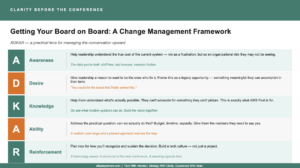
We walked through the ADKAR change management model in the webinar — not as a theoretical framework but as a practical tool for thinking about what board members actually need to move from awareness to action. Understanding the difference between a board member who lacks information and one who lacks desire changes how you approach the conversation entirely.
One thing that came up that we found genuinely useful: framing the decision in terms of legacy. The board members who champion technology transformation tend to be the ones who can see what it would mean for the organization — and for their tenure — to be the person who led that change.
If you're heading to AMS Fest, go in knowing yourself.
For those attending AMS Fest DC in September, the webinar also covered how to make the most of Demo Days once you're there — and what to do before you arrive.
The short version: know where you are in your process before you walk in. Know your size, your non-negotiables, and your two or three biggest pain points. That clarity makes every conversation more useful — with vendors, with consultants, and with the peers you'll meet over breakfast.
We're also running a WhatsApp group for AMS Fest attendees this year — a low-key way to stay connected before and during the event. Scan the QR code below to join.

Take These With You
We're sharing these resources from the webinar — free to download and designed to make the work more concrete:
The Tech Debt Worksheet walks you through the four-step process for documenting your current state, evaluating impact, envisioning a future state, and comparing the cost of change against the cost of staying put.
The AMS Solutions List by Organization Size gives you a starting point for understanding which systems are built for organizations like yours — before you sit through a single demo.
→ Download the Tech Debt Worksheet
→ Download the AMS Solutions List by Organization Size
Ready to go further than a resource?
Ellipsis Partners helps associations build the case for new technology, navigate vendor selection, and move through implementation with confidence. If you're trying to figure out where to start — or how to get unstuck — we'd love to talk it through.
No agenda, just a conversation.